

For decades, contact centers have been managed by the same familiar scorecard.
- Average handle time (AHT)
- Service levels
- CSAT
- Cost per contact
- NPS
There’s a reason 85% of contact centers are leveraging these legacy metrics. They are tidy. They benchmark well. They fit neatly into dashboards.
They also leave most executives with the same lingering question once the meeting ends: “So what did this actually do for the business?”
That gap used to be survivable. It no longer is.
Margins are thinner. Scrutiny is higher. And AI has moved from experiment to expectation. Leaders are being asked to invest real money in automation, analytics, and self-service without a clear way to explain what success looks like in financial terms.
The problem is not a lack of data. The problem is that the data speaks a language few outside the contact center understand.
Metrics Explain Activity, Not Business Impact
Operational metrics describe what happened. They do not explain why it mattered. For example…
- AHT tells you how long an agent stayed on the line. But it does not tell you whether that call prevented a cancelation, saved a renewal, or avoided a repeat contact tomorrow.
- CSAT captures how a customer felt in the moment. But it does not tell you whether that feeling changed their behavior next month.
- NPS suggests advocacy. But it rarely shows up cleanly in a revenue forecast.
These metrics are accurate. They’re also incomplete.
Ask a CFO what they need from the contact center, and the vocabulary changes immediately.
Cost. Margin. Retention. Payback period.
When customer experience (CX) performance is framed in averages and sentiment scores, leaders outside the function are left to infer business impact.
That is why contact center leaders often describe ROI as “directionally correct.” They sense the value. But they can’t defend it with the financial rigor of other business units, such as sales or product development.
That’s also why your contact center operations are often viewed as a cost center. In practical terms, this is why your contact center will too often fail to get the resources you need and the respect you deserve from the rest of the organization. You get a pat on the head rather than a firm handshake.
Averages Are Flattening Economic Reality
Today’s economy is moving to a K-shape. Customers are now split between a vast majority with limited incomes and a small elite that have the most buying power.
As a result, most organizations now serve two very different customer realities at the same time.
- Group One is highly price sensitive, loyal through inertia, and willing to tolerate friction if switching feels harder than staying. Airlines, utilities, broadband providers, and enterprise software contracts primarily live here.
- Group Two is smaller, more demanding, and far more valuable per interaction. These customers (like high-spend customers with contractual SLAs) expect fast resolution, context, and minimal effort. They expect it every time.
But traditional averages collapse both groups into a single number. For example, a five-minute AHT hides 10-minute interactions that protect meaningful revenue and one-minute interactions that barely matter. Treating them as equivalent feels efficient. But it quietly misallocates effort and cost.
This flattening effect makes it difficult to design service strategies that align with real business priorities. High-impact interactions get optimized for speed when they require care. Low-impact interactions absorb time and cost because they look identical on a dashboard.
AI Exposed Measurement Problems
AI was supposed to simplify the equation. Think: Fewer calls, shorter interactions, and lower costs. Instead, it revealed how little organizations know about the financial impact of service decisions.
Consider a chatbot that deflects thousands of contacts. On paper, the savings look obvious. In practice, savings are rarely recouped. Some customers circle back through another channel. Others escalate more frustrated than before. A few quietly churn weeks later.
If success is measured by deflection alone, the initiative looks like a win. If success is measured by avoided cost, the story likely changes. This gap explains why so many AI pilots feel successful and still underdeliver.
(Don’t just take my word for it. Notable industry reports have shared the same takeaway.)
Measured activity goes down. Dashboards improve. Confidence rises. But financial results remain stubbornly unclear (at best).
The issue is not the technology itself. It is the absence of metrics that connect AI performance to outcomes leaders actually care about. This leads me to my next point.
Why Financial Precision Breaks Down…
There is a structural reason ROI — measurable ROI, that is — remains elusive in contact centers. Operational metrics like AHT are built from the ground up. Every interaction has an owner. Every minute has a source. Leaders can trace performance down to a queue, a team, or an individual agent.
Financial metrics move in the opposite direction and are built from the top down. Total cost is allocated across contacts, minutes, or customers. The result is a clean average that assumes every interaction contributed equally.
That assumption is convenient. It is also incorrect.
There’s a structural mismatch between operational data and financial reality (see FIGURE 1).
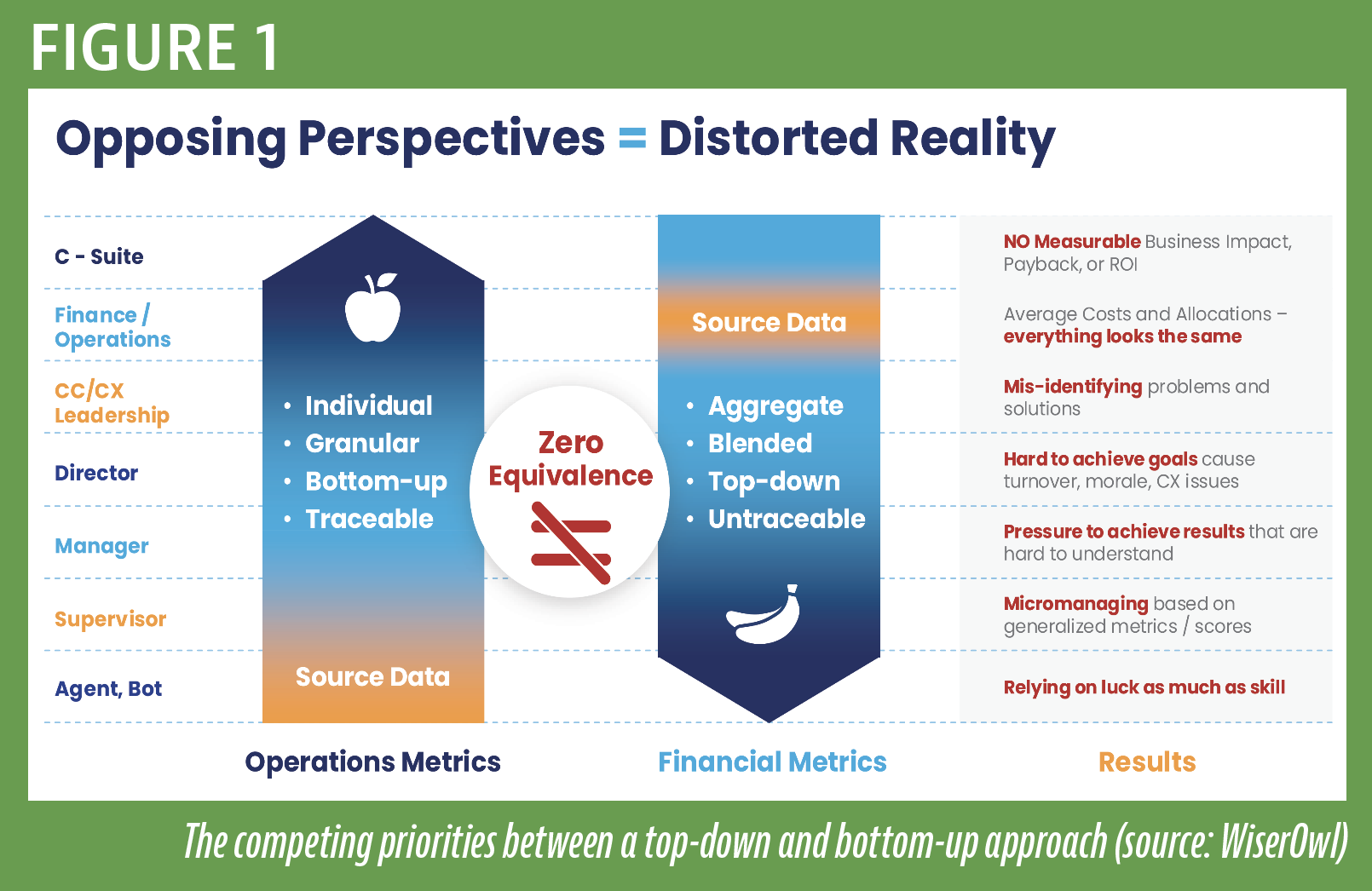
Some contacts cost far more than average. Others cost almost nothing. When everything is spread evenly, leaders lose visibility into where money is actually being spent and where it is quietly wasted.
And when 45% of contact center leaders want their CX operation to do more with less, that monetary invisibility is a liability. This is also why organizations can debate cost per contact endlessly and still hesitate to invest or cut. The number looks credible. The story behind it is missing.
…And How to Fix It
The shift required to fix this is conceptually simple and operationally demanding.
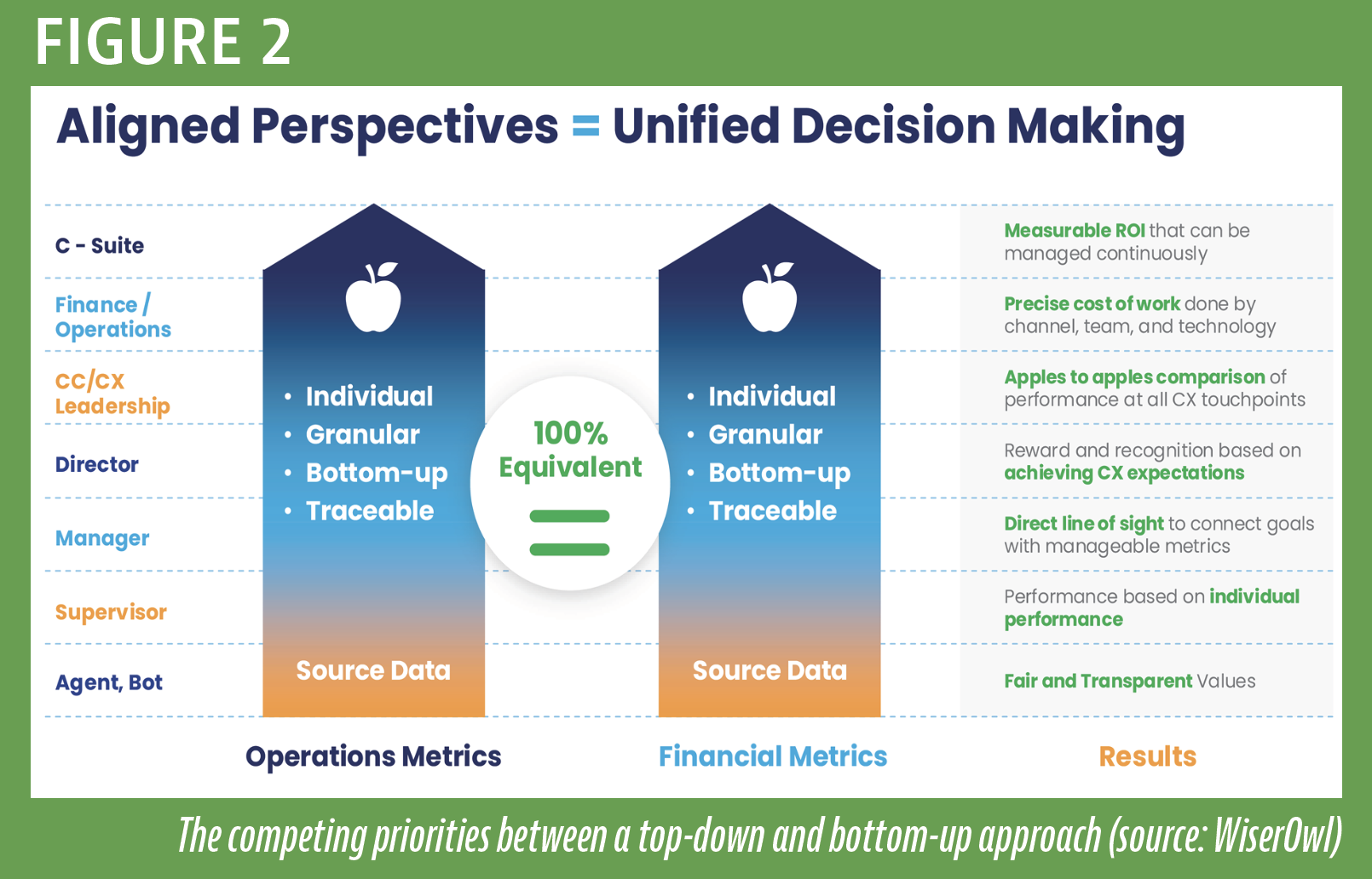
Operational and financial performance must be measured from the same starting point (see FIGURE 2). That means calculating the actual cost of interactions at the level where work happens. Agent time. Channel usage. Technology consumption. Overhead tied to real activity for each customer interaction.
Once that foundation exists, the fog lifts.
Payback periods stop being theoretical. The cost of supporting a product line becomes visible. Marketing campaigns can be evaluated based on the customer service demand they create. AI investments can be judged on outcomes finance teams recognize.
Give Metrics Financial Weight
A bottom-up approach produces a different class of metrics, ones that stop describing motion and start explaining consequences.
What’s more, we’re seeing boards and CFOs increasingly demanding an alignment between contact center performance and enterprise financial priorities.
This way of measuring costs will reflect what actually happens across channels and roles rather than smoothing everything into a comfortable average. ROI is tracked continuously, so small inefficiencies show up early, before they quietly erode margin.
The future of contact center measurement is not about cleaner dashboards. It is about telling the truth clearly.
Familiar KPIs like AHT and CSAT are translated into financial terms, allowing leaders to see, in plain dollars, what a single minute of extra effort really costs.
Process inefficiencies become visible as daily drains on time, money, and capacity. AI performance is judged by whether issues are resolved, customers are retained, and expense is genuinely avoided.
Business Metrics Change Contact Center Roles
One-time snapshots invite debate. Continuous measurement invites action.
When costs rise unexpectedly, leaders can see whether overtime, channel mix, or underused automation is responsible.
When AI performance degrades, the financial impact appears before customers start complaining. (That is, if they complain at all instead of fleeing to your competitor: which 72% of customers would do.)
Over time, this discipline reshapes conversations with finance, IT, and product leaders. Requests stop sounding reactionary. Instead, they start sounding like proactive business cases.
Metrics now begin to make sense to the broader enterprise. Product leaders understand how service affects renewals. Finance trusts that savings are real. Boards see whether AI protects margin or merely shifts work around.
As contact center metrics become a feature of enterprise conversations, the role the contact center plays also changes. It stops being an operational silo and becomes a strategic arm that product and service leaders can reason about, invest in, and optimize with confidence.
The future of contact center measurement is not about cleaner dashboards. It is about telling the truth clearly.
So, this time, when executives ask, “What did this actually do for the business?” they have clear answers.
- Which interactions cost the most?
- Which ones protect the most value?
- Which technologies earn their keep?
- Which investments quietly miss the mark?
AI has raised the stakes. Economic pressure has narrowed tolerance for guesswork.
The organizations that adapt will stop measuring activity and start measuring impact. The rest will continue to feel directionally right while wondering why the numbers never quite add up.
This article appears in March 2026.
