

Coaching isn’t just a checkbox: it’s a bridge. A bridge between where an agent is today and the untapped potential waiting just ahead.
Sometimes it’s about helping a mediocre or good agent become a standout performer. At other times, it’s a much harder conversation – one that, if handled correctly, can help someone course-correct before they end up on a performance plan – or worse.
But here’s what I’ve learned: coaching only works when we make it personal.
That doesn’t mean being soft or lowering expectations. It means seeing the human behind the headset.
Every coaching conversation is different because every agent is different. What helped Susie turn around her attendance issues might not move the needle for Jackie, who’s struggling with adherence. Even if the issue appears the same on paper, the root cause, mindset, and motivation—all of that—are unique.
And truthfully? Each coaching session has taught me something as well. Like the game Call of Duty, it’s pushed me to go back to the drawing board: rethink my strategy, adjust my aim, and consider a different approach the next time. Coaching has made me sharper, more thoughtful, and more intentional.
Still, I know how tempting it is to avoid challenging conversations. Many of us are confrontation-averse, uncertain of how the agent will respond or how to say the right thing without escalating the tension. But if we delay, we miss the moment.
The best time for a coaching conversation is when both parties are calm and clear-headed – not overly emotional – and as soon as possible.
Avoiding it is like seeing a colleague with toothpaste on their face and hoping someone else says something. It might feel more comfortable in the moment, but the respectful, human thing to do is to speak up with care.
To build a bridge you need the right tools. And every location where bridges are built is unique.
In this article, I’ve highlighted some of the ones I’ve come to rely on that help shape the conversation to the individual. I hope you find them useful as you guide your teams, build trust, and strengthen performance: one coaching conversation at a time.
Tool #1: Speak Their Language: Using DISC
One of the biggest turning points in my coaching journey came when I realized this simple truth: not everyone thinks, acts, or responds like I do. And that’s not a bad thing: it’s just finding out what communication style works for the other person.
That’s where the DISC model comes in (see FIGURE 1). Or as Thomas Erikson colorfully puts it in the Surrounded by Idiots book series, it’s about understanding how people communicate based on four distinct behavior types: Red, Yellow, Green, and Blue.
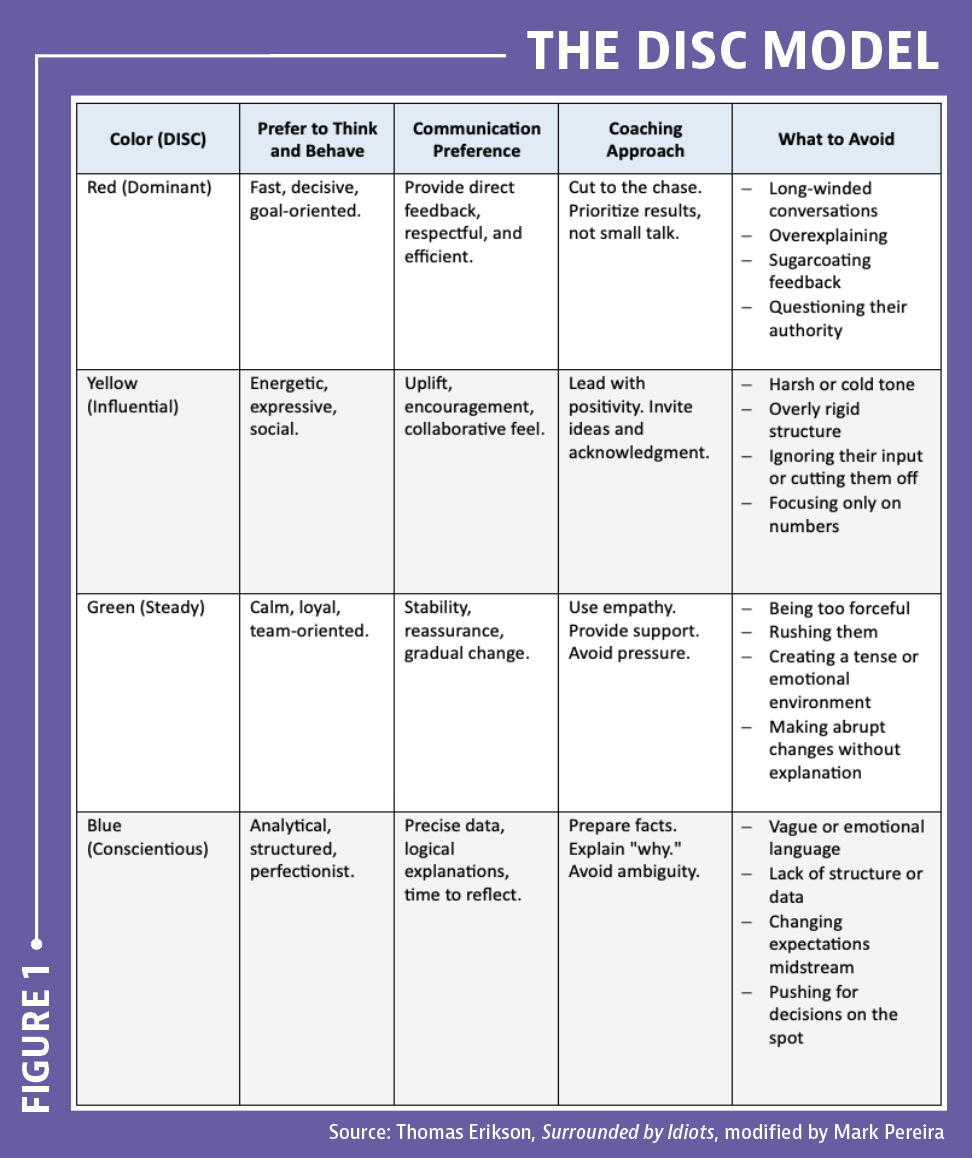
Here is a simplified approach that I have adapted for call and contact centers:
I remember a coaching session with Janice, who is one of our experienced agents, but whose hold time was consistently higher than her peers.
At first glance, it looked like a performance issue. But I knew Janice; she wasn’t careless or unmotivated. She was a strong performer in many areas, which made this trend a bit curious.
Through conversations and observation, I had a good sense of Janice’s personality; she was a mix of Red (dominant) and Blue (conscientious). That meant she cared deeply about getting things right, but she also wanted to be in control and come across as competent with peers and callers.
So, I approached our conversation directly, not in a critical way, but with clarity and purpose. I told Janice, “Your hold time is higher than expected.” I showed her the data for the month and even brought up a few specific calls from that day where the hold times were unnecessarily long.
As we talked, it became clear that the real issue wasn’t that she was distracted or lazy. Instead, it was information overload.
Janice was placing customers on hold because she couldn’t quickly locate the right resources or information.
Her desktop was covered in Microsoft Sticky Notes, with everything from system passwords to website links scribbled in different colors, all competing for her attention. Then she had two notepads filled with information, which she also used to help answer questions.
I didn’t lecture Janice as I knew it would be of no use. Instead, I walked over to her desk and said, “Let’s figure this out together.”
I introduced her to OneNote: a simple digital tool that could help her organize and centralize all those scattered notes. Within minutes, she was copying her most-used links, key facts, and troubleshooting guides into a single, searchable document.
The result? By the following week, Janice’s hold time was cut in half.
That experience reminded me of something important. Most people aren’t just one color on the DISC spectrum. Janice had the drive of a Red and the structure-focused mindset of a Blue. That combination influenced how she processed information and how she responded to coaching.
And it’s not always static. An agent might come across as a Yellow (influential) on the phone – energetic, chatty, full of personality- but shift to a Green (steady) style in team meetings, preferring to observe and maintain harmony rather than speak up.
The point is that coaching isn’t about applying a one-size-fits-all template. It’s about noticing what makes each person tick and then tailoring your approach to help them thrive.
Tool #2: Moving from Style to Readiness: The Will vs. Skill Matrix
Understanding your agents’ personality styles is a powerful first step. But knowing how ready they are to improve is just as essential.
That’s where the skill versus will matrix comes in, which I have modified and broken down for call and contact centers, outlined in four quadrants (see FIGURE 2).
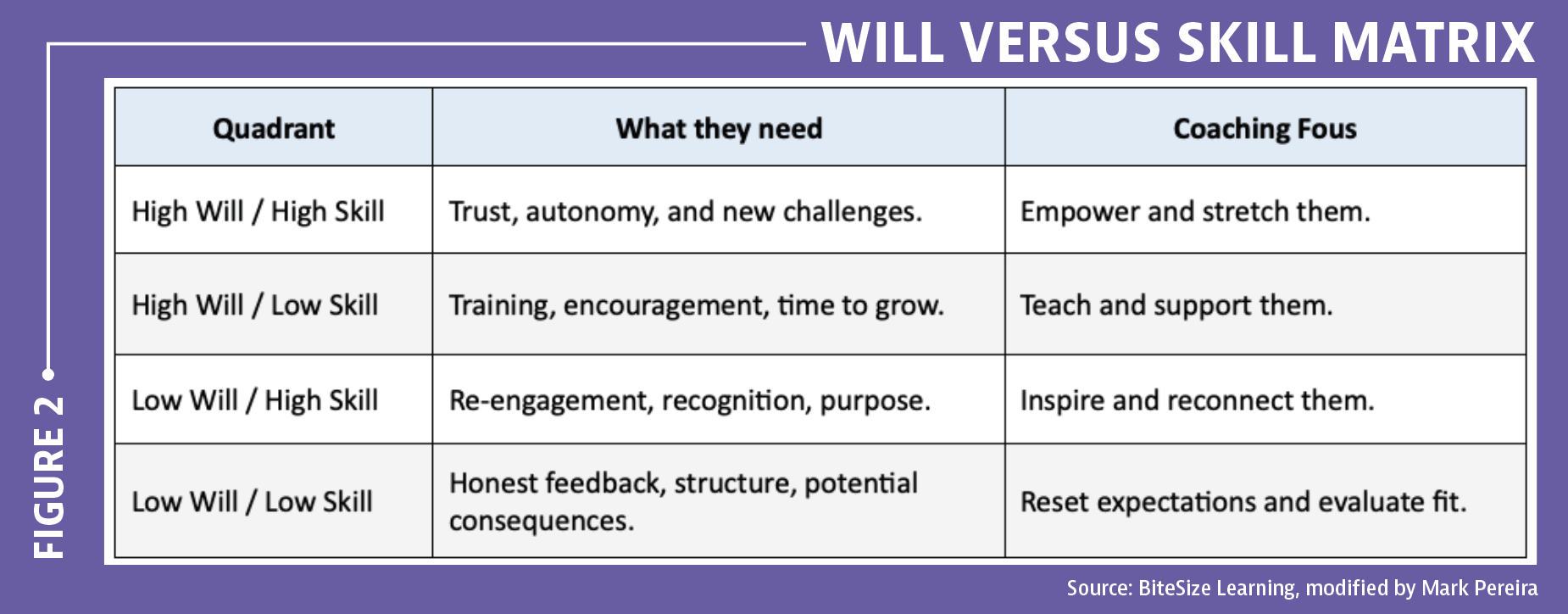
This simple yet powerful framework helps you diagnose where an agent is on their coaching journey by looking at two things:
- Skill. Do they have the ability and knowledge to do the job?
- Will. Do they have the motivation and mindset to apply it?
Once you understand both, you can coach more precisely: offering the right blend of support, challenge, or encouragement depending on where they land.
Let’s see how these quadrants can be used:
- High Will/Low Skill. Think of a brand-new hire, bright-eyed and bushy-tailed, hitting their head against a brick wall trying to get the hang of your call center’s CRM system. They’re motivated but may flounder without guidance.
- Your job? Teach with patience; they want to succeed. Consider pairing them with a mentor (an experienced agent) to learn the ropes.
- Low Will/High Skill. This one is trickier. Imagine an agent who knows the systems and information inside out but who rolls their eyes at feedback. Something’s off. Burnout? Misalignment? Your job is to dig deeper and help them reconnect to their “why.”
- Low Will/Low Skill. This agent has checked out. Maybe they weren’t appropriately trained or felt they would figure it out when they started taking calls, or perhaps they’re not a good fit.
- Here, coaching will be challenging; most times, it falls on deaf ears and such agents will do their best to hold on until they find something to move on to. However, if it’s a training issue, and the agents are willing to learn, there may still be hope to turn things around.
- High Will/High Skill. These agents are your MVPs. Don’t ignore them because they’re consistent.
- Instead, invest in them like by offering stretch assignments (new assignments that push their skill level and challenges them to grow, such as leading team huddles or piloting a new system), mentorship, or leadership prep.
Using the Will vs. Skill Matrix in your coaching prep helps you match your strategy to their reality: and sets you both up for more productive, empathetic conversations.
Tool #3: What Fuels the Fire
If DISC helps us understand how someone behaves, and the Will vs. Skill Matrix tells us where they are in their development, there’s still one big question left:
Why do agents do what they do?
That’s where what I call “driving forces”, based on extrinsic and intrinsic motivation, described by Charlotte Nickerson, that I have modified for call and contact centers come in (see FIGURE 3).
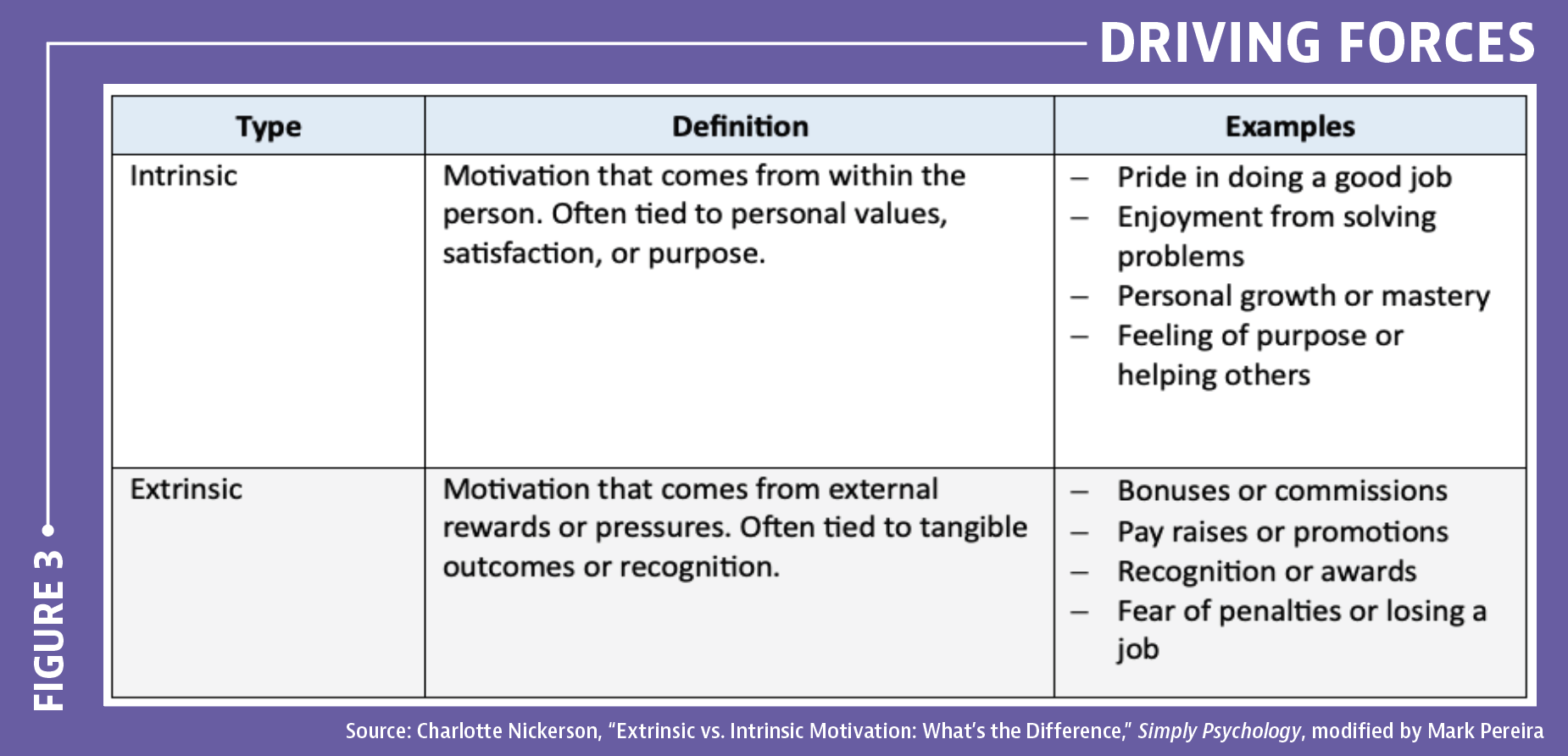
In the fast-moving, high-pressure world of call and contact centers, it’s easy to assume that everyone is motivated by the same things: recognition, bonuses, maybe a shot at promotion, and the list goes on.
But in reality, motivation is deeply personal. Two agents might hit their targets for totally different reasons: one to feel competent and independent, the other to help their team make a difference in the world.
And when you don’t know what drives someone, even the best coaching strategies can fall flat. Like trying to fuel a car with the wrong gas. You might mean well, but it’s not going anywhere.
That’s why taking the time to understand an agent’s driving forces – the “whys” behind their behavior – can make a significant difference. It brings clarity to those challenging conversations, uncovers what they care about, and gives you a direct line to what inspires them to put in their best effort.
Every coaching moment – whether it’s scheduled or spontaneous – is a chance to grow. Sometimes you’ll hit a home run. Other times, you’ll walk away wondering if it even made a difference.
I remember meeting with an agent who consistently skipped her breaks and cut her lunch down to just 15 minutes. When I asked her about it, she explained, “Calls are waiting; I just want to do my part to help us meet service levels.”
Her heart was in the right place. She genuinely cared about the team and the callers. But as we know, this kind of well-intentioned behavior can lead to burnout and even legal trouble.
Rather than confronting her head on, I took a different approach. I explained that adherence wasn’t just a checkbox metric: it was an important performance metric that gets reported to the client.
I told her that skipping breaks might seem noble in the moment, but it lowers her adherence score and impacts the center’s overall performance.
I also reminded her that, by law, anyone working an eight-hour shift is entitled to two 15-minute breaks and a 30-minute lunch. Not following that not only affects her wellbeing, but it also puts the organization at legal risk.
After our conversation, something shifted. She started taking her breaks and lunches on time and for the allotted durations.
Empathy: The Leadership Bridge
I hope these tools serve you well in your coaching conversations: just as they’ve helped me over the years.
And here’s one more piece of advice: always lead with empathy. It’s the bridge that connects you with your agents, especially in challenging moments. Review the article on “Why Empathy in Leadership Matters”.
Coaching isn’t something most of us naturally excel at: it’s a skill we build over time. I wish it were something you could learn once and be done with, but the truth is, it takes ongoing practice, reflection, and patience.
Every coaching moment – whether it’s scheduled or spontaneous – is a chance to grow. Sometimes you’ll hit a home run. Other times, you’ll walk away wondering if it even made a difference.
But keep showing up. Because those small, consistent conversations are where real development happens. For you and your agents.
So, stay curious, stay empathetic, and most importantly stay calm and carry on coaching.
This article appears in February 2026.
