


The profit engine of any successful call center rests on two cornerstones: retaining skilled agents and minimizing sick leave. These aren’t peripheral metrics; they drive revenue and operational costs directly.
But the ground beneath that foundation is shifting. As AI transforms customer service delivery, talent management strategies must evolve just as rapidly.
We’re entering a phase where profit margins for low-complexity tasks will steadily shrink until they disappear altogether. The foundational pyramid of the contact center is inverting, eliminating a large portion of entry-level roles.
Agents will no longer be script readers. They’ll handle escalation calls, solve non-standard problems, navigate emotionally charged situations, and integrate with AI systems.
While AI takes over routine tasks, remaining roles become more complex, emotionally taxing, and cognitively demanding. That makes retention even more critical: and sick leave more costly.
Without a shift in how call centers recruit, train, and support their people, organizations risk increased turnover costs, reduced productivity, and a direct hit to profitability.
The Emotional Labor Challenge
Call center jobs are what psychologist Christina Maslach calls “contact work”: roles requiring constant emotional labor. Agents must remain composed, empathetic, and effective while interacting with frustrated or confused customers.
Even before AI, these roles had some of the highest turnover rates across industries. This raises a strategic question for call center leaders: how do we identify people who can handle the pressures of this work? (See BOX on leadership implications.)
Leadership Implications
The emotional labor issue goes beyond stress, tenure, and sick leave. Employees with the insecure overachiever profile are less comfortable with evaluation and more likely to interpret feedback as personal criticism. That’s why leaders get lower ratings from individuals with this profile.
Understanding this difference, between how individuals respond to feedback, opens a powerful opportunity for call center managers. Leaders can be trained to adapt their coaching style based on whether an employee has the insecure overachiever profile or not.
This tailored approach can drastically improve leadership efficacy across the center. When employees improve self-leadership around their psychological drivers and managers adjust their leadership accordingly, both parties meet halfway.
The result is the creation of a true co-leadership dynamic. One that transforms feedback from a source of stress into a catalyst for growth.
Beyond Neuroticism: A Better Predictor
Traditional recruitment models have relied mainly on the Big Five trait “neuroticism” to estimate stress sensitivity (see BOX on Big Five traits). But emerging research suggests this isn’t the best predictor at all.
The Big Five Traits in Contact Centers
The Big Five — also called the Five-Factor Model — is arguably the most commonly-used personality framework in recruitment. It groups traits into five broad dimensions:
- Openness (curiosity, creativity)
- Conscientiousness (organization, reliability)
- Extraversion (sociability, assertiveness)
- Agreeableness (empathy, cooperation)
- Neuroticism (emotional reactivity, stress sensitivity)
These traits reliably predict job performance, stress, and more.
That’s why the Big Five underpins many widely used recruitment tools: including Hogan HPI, SHL OPQ32, Criteria’s EPP/CPI, PMaps’ BPO screener, PI Behavioral Assessment, Traitify – and various tests from vendors like TestGorilla, TestGroup, and HiPeople.
But there’s a limitation: Big Five traits are stable and hard to change, making them less useful for training. In contrast, models focused on malleable traits — like perfectionism and performance-based self-esteem — offer sharper insights and clearer paths for development.
Furthermore, emerging research suggests that the insecure overachiever profile may outperform the Big Five in predicting stress, burnout, and early turnover risk.
A significantly more accurate predictor of burnout, especially in high-pressure environments like call centers, is the combination of two traits:
- Performance-based self-esteem (“I am only worthy if I succeed”).
- High ambition (“I must always perform at my best”).
This blend creates the insecure overachiever. These individuals often look ideal on paper: high grades, strong drive, impressive performance. But they’re also much more prone to burnout, have difficulty accepting feedback, and incur stress-related leave.
This vulnerability stems from a psychological mechanism; when self-esteem is tied to performance, feedback isn’t just feedback, it’s personal. If a customer or supervisor is unhappy, it feels like a rejection of one’s worth.
When employees don’t feel adequately prepared to handle difficult conversations, they begin to perceive their work as more demanding…
People with this profile also tend to take disproportionate responsibility for others’ satisfaction, making them especially sensitive in emotionally charged conversations. In the fast-paced world of contact work, where complaints and dissatisfaction are part of the job, this sensitivity becomes a very real risk factor.
Ambitious and driven, these individuals set high standards for themselves. So, when customers express frustration or dissatisfaction — as they inevitably do — these agents experience sharper disappointment and internalize the negativity more deeply.
In outbound call settings, this same combination can reduce assertiveness. The desire to be liked may override the drive to convert or close, making them less pushy or competitive than the role requires.
The Data: Six Critical Patterns
I’ve conducted several studies in call centers in both the U.S. and the Nordic countries. In one U.S.-based study involving 289 call center agents, I observed clear patterns linking psychological traits to real-world outcomes.
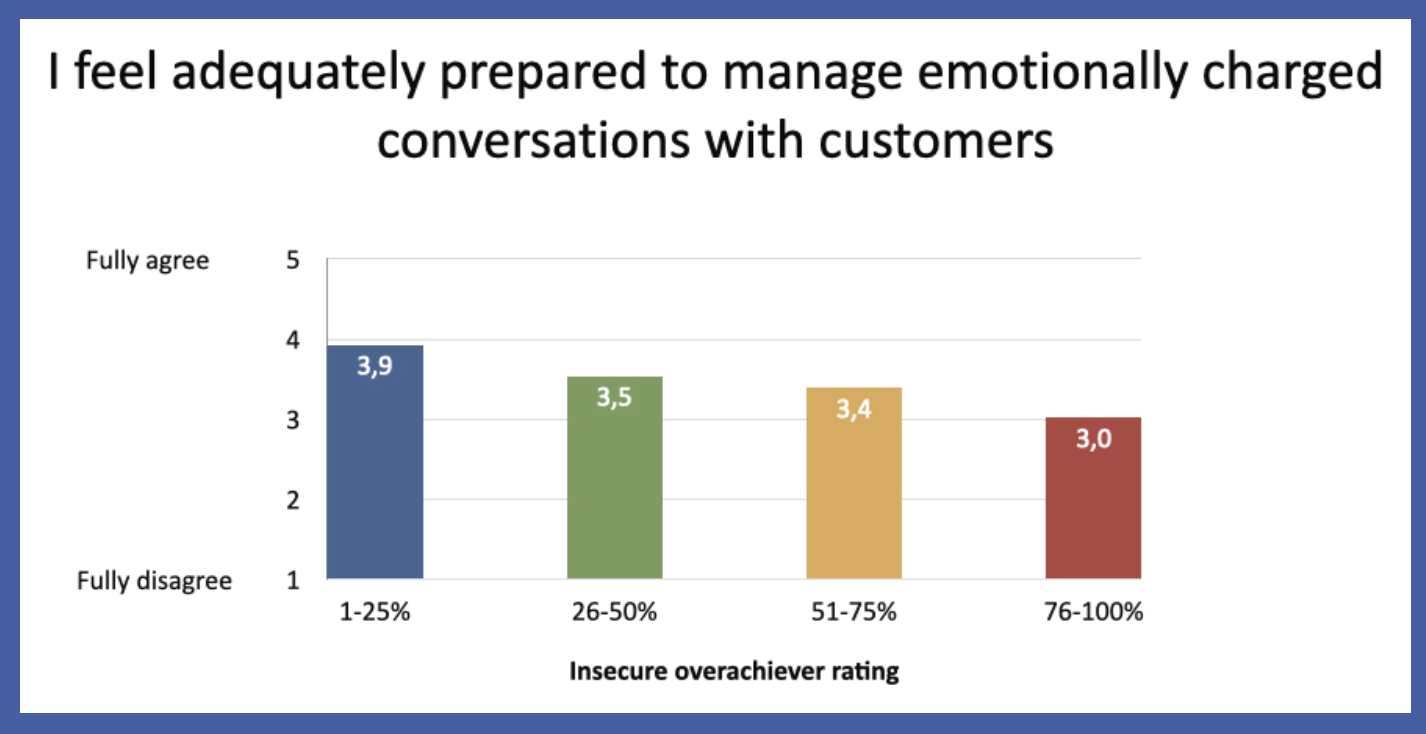
Pattern 1: Lower Preparedness for Emotional Demands
Insecure overachievers report feeling less prepared to manage emotionally charged conversations with customers. Those with performance-based self-esteem and high ambition tend to feel less equipped to handle the emotional strain, even when they have the same training as their peers.
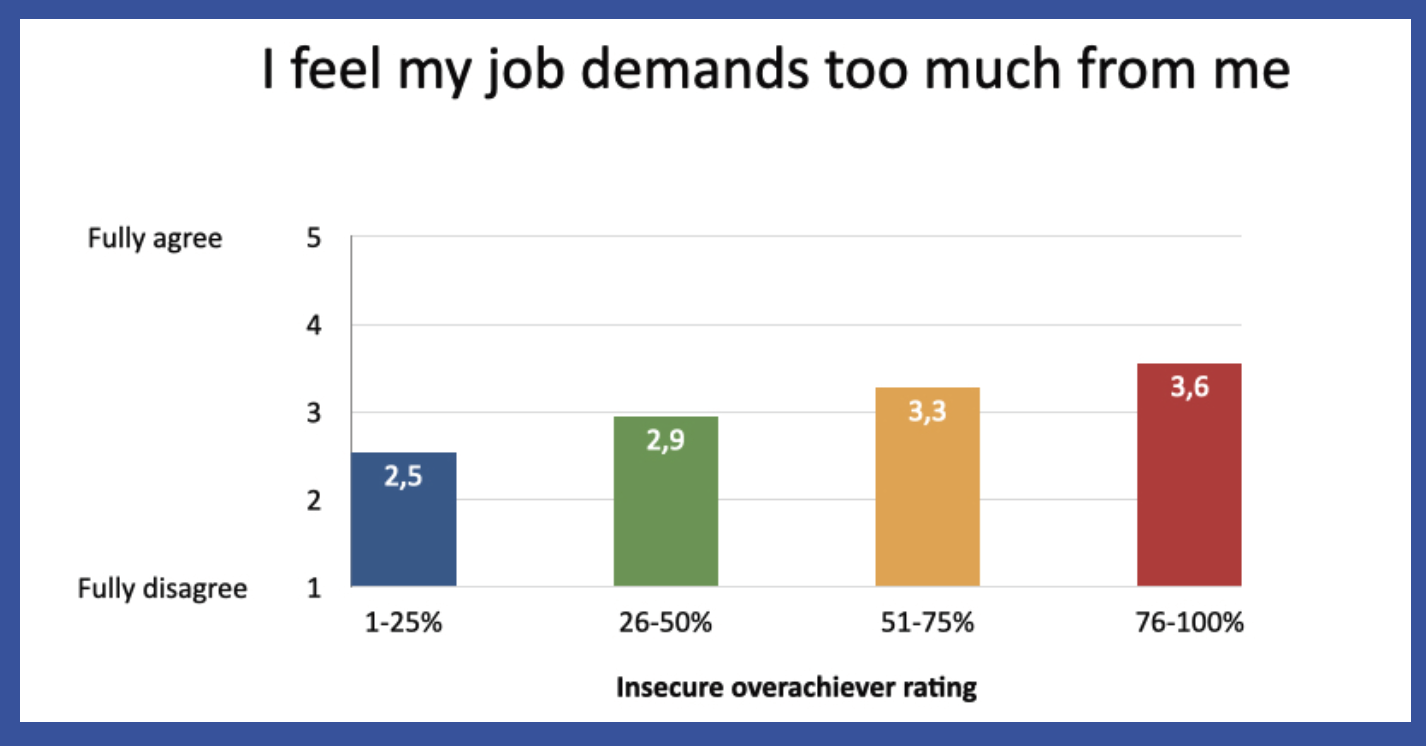
Pattern 2: Perceived Workload Amplification
When employees don’t feel adequately prepared to handle difficult conversations, they begin to perceive their work as more demanding than others do, even though they have the same workloads. Lack of preparedness correlates with these perceptions, regardless of actual task volume.
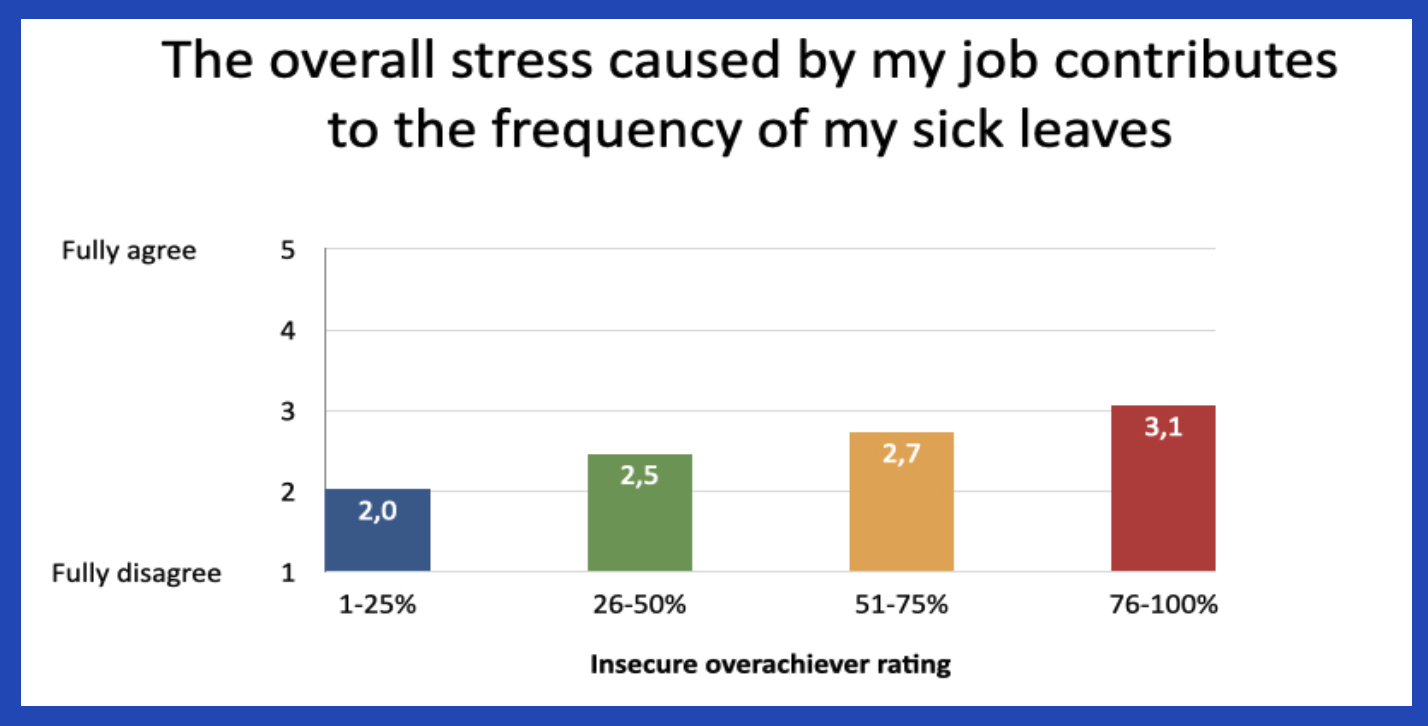
Pattern 3: Sick Leave Intention
This elevated perception of job demands translates into higher levels of experienced stress. And that stress correlates strongly with increased intention to take sick leave. Higher stress levels predict greater likelihood of absence: a strong early warning signal for turnover.
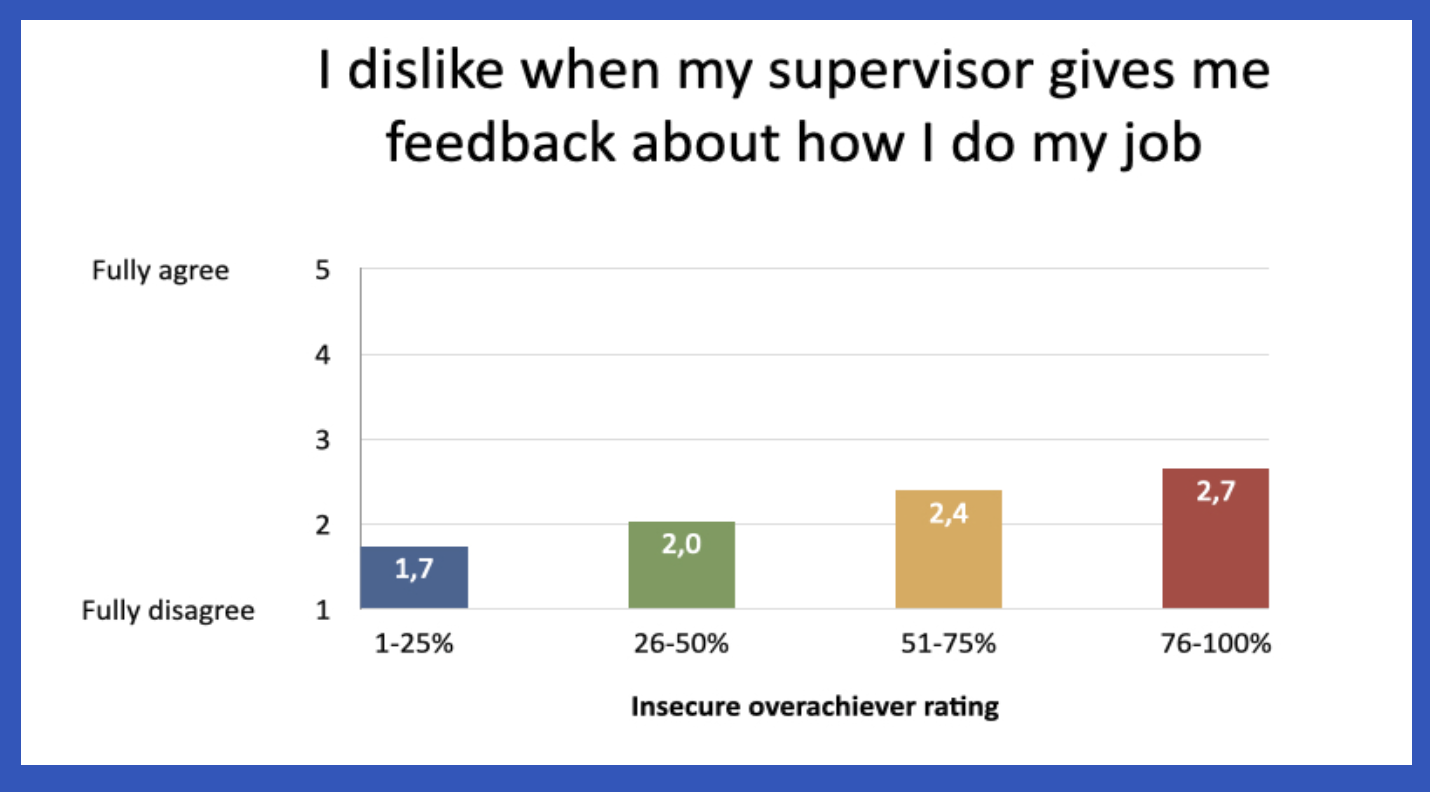
Pattern 4: Feedback Sensitivity
Performance-based self-esteem affects how employees receive feedback. Individuals with this trait report a stronger negative emotional reaction to being evaluated and tend to give their leaders lower ratings.
Pattern 5: Job Satisfaction Decline
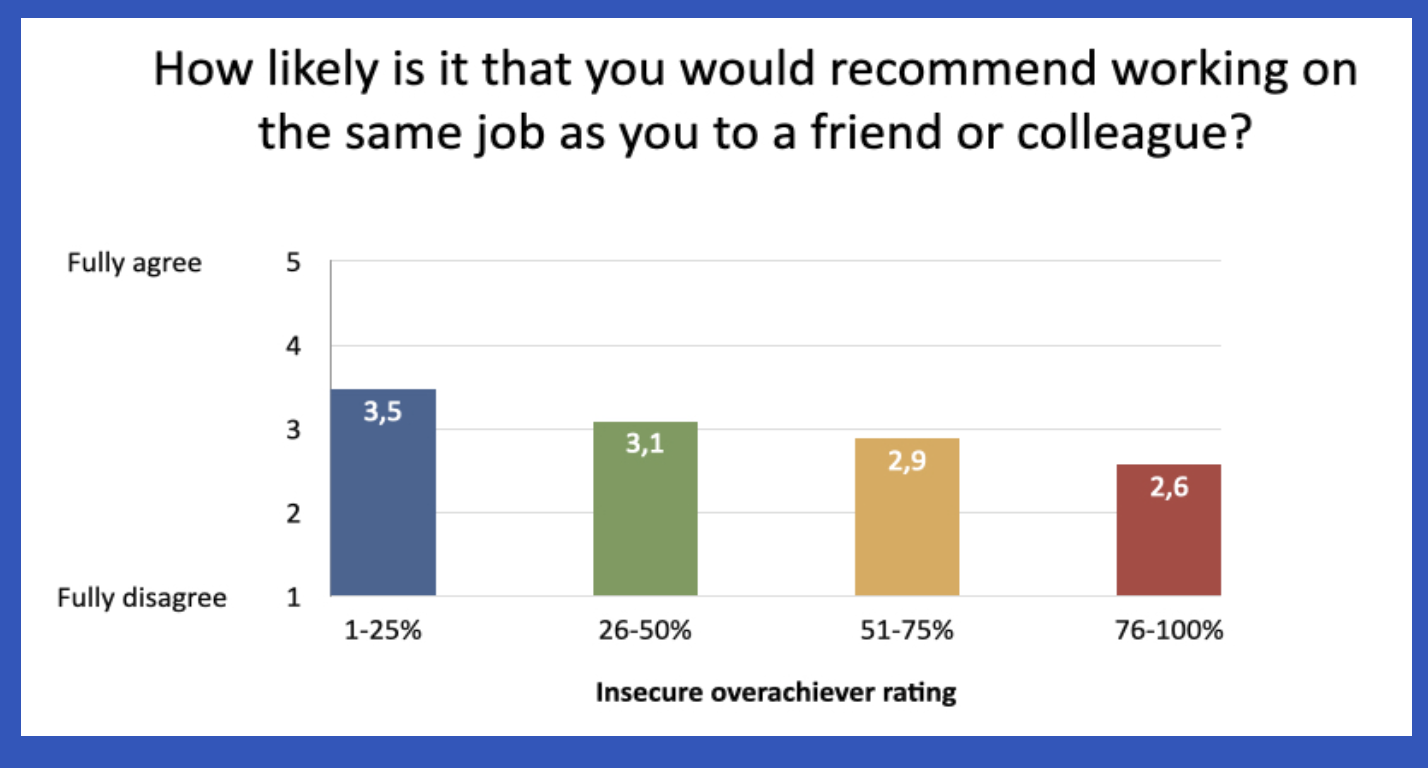
Patterns 1-4 compound over time, thereby eroding the agent’s connection to their work. Overall job satisfaction drops significantly for profiles with high ambition and fragile self-worth.
These agents become less engaged with their role and less likely to recommend their workplace to others. What started as enthusiasm and drive gradually transforms into disillusionment and detachment.
Pattern 6: Increased Turnover Intent
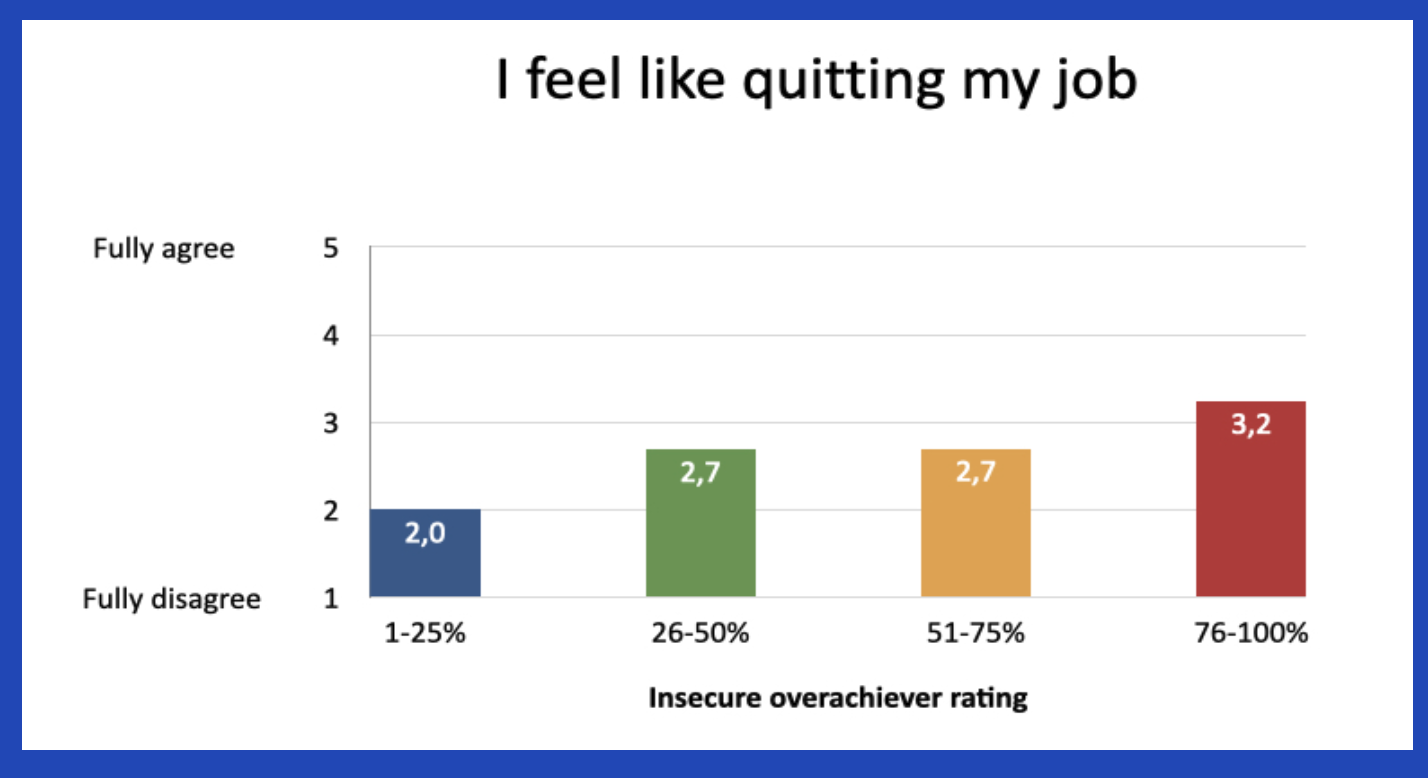
This culminates in a higher intention to quit, which is the strongest predictor of actual turnover. Agents who link their self-esteem to performance outcomes are significantly more likely to consider leaving their positions.
By the time an agent expresses intention to quit, the organization has often already lost the battle for retention. The cost isn’t just in replacement and training; it’s in the months of diminished performance leading up to their departure.
Together, these findings reveal that this psychological profile isn’t a niche HR insight: it’s a fundamental business variable. It predicts who will stay, who will thrive, and who will burn out.
We can conclude with confidence that this factor correlates strongly with:
- Tenure length
- Job satisfaction
- Burnout risk
- Leadership ratings
- Feedback tolerance
These findings align with a growing body of peer-reviewed research on the insecure overachiever profile and workplace outcomes.
What I’m observing in call centers mirrors patterns documented across high-pressure, customer-facing industries: confirming that this isn’t just correlation, but a robust and replicable phenomenon.
Recruitment Impacts
Here’s where the insecure overachiever trait is becoming critical. It is sharply on the rise, particularly among younger generations.
Large-scale studies, such as this one published in Psychological Bulletin that examined generational differences show that Gen Z, especially young women with strong academic records, are increasingly tying their self-worth to external success.
…the humans who will thrive in this new environment will need more than empathy or quick thinking. They’ll need mental resilience, emotional endurance, and the right support systems.
Since this wasn’t a common factor until recently, it’s been missed in traditional recruitment models. This creates a paradox for recruiters: the very traits that make someone look hireable — being ambitious and taking personal responsibility — can also signal vulnerability.
If unchecked, this feeds the cycle of churn and stress-related absenteeism.
A Progressive Solution
So how are HR leaders to resolve this paradox?
One option is to identify and filter out insecure overachievers during recruitment. This is certainly the simplest and most cost-effective approach in the short term.
But there’s a more progressive — and sustainable — approach: equip them to thrive. The psychological tendencies that underlie insecure overachievement are not hardwired; they are malleable. If they weren’t, they wouldn’t have increased so sharply in response to social and digital environments.
The truth is that these psychological patterns have been addressed in cognitive behavioral therapy for decades.
Building on this knowledge, I developed a brief psychometric assessment that accurately identifies insecure overachievers. It equips them with tools to manage their inner drivers more constructively, reducing stress and increasing staying power.
These are bright, hardworking, and driven individuals. With the right support, they don’t just survive in call centers: they can thrive.
The Path Forward
The rise of AI doesn’t eliminate the need for humans in call centers: it elevates it. But the humans who will thrive in this new environment will need more than empathy or quick thinking. They’ll need mental resilience, emotional endurance, and the right support systems.
In a world where machines can talk, human connection and resilience become premium assets. The question isn’t whether to assess employees and prospective hires for psychological fit: it’s whether you can afford not to.
Addressing the insecure overachiever challenge can take different forms depending on organizational maturity and resources.
At minimum, psychometric screening during recruitment can help identify high-risk profiles and inform hiring decisions. But the gold-standard approach is three-dimensional.
First, use assessment data not just to select, but to prepare, identifying candidates who may need additional support and planning for their success from day one.
Second, implement targeted development programs that help agents build psychological skills to manage their inner drivers more constructively.
Third, equip managers with training to adapt their coaching and feedback styles to different psychological profiles, creating more effective relationships across the team.
Organizations that integrate these elements into their talent strategy will be better positioned to:
- Reduce churn and turnover costs.
- Increase job satisfaction and engagement.
- Deliver outstanding customer experiences.
- Build resilient, high-performing teams.
In a world where machines can talk, human connection and resilience become premium assets. The question isn’t whether to assess employees and prospective hires for psychological fit: it’s whether you can afford not to.
This article appears in March 2026.
